Monday, August 5, 2013

Labor Force Update

Image

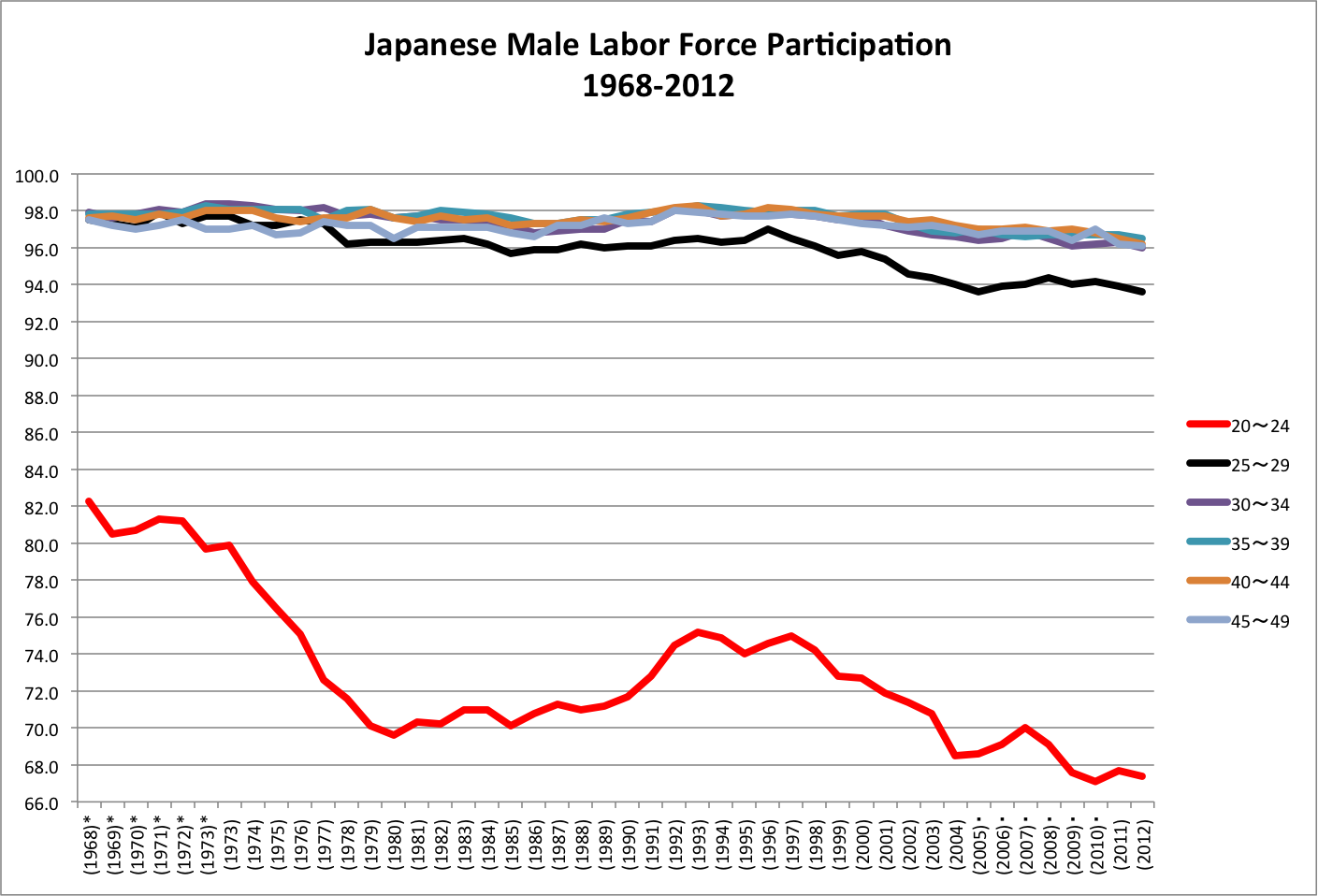
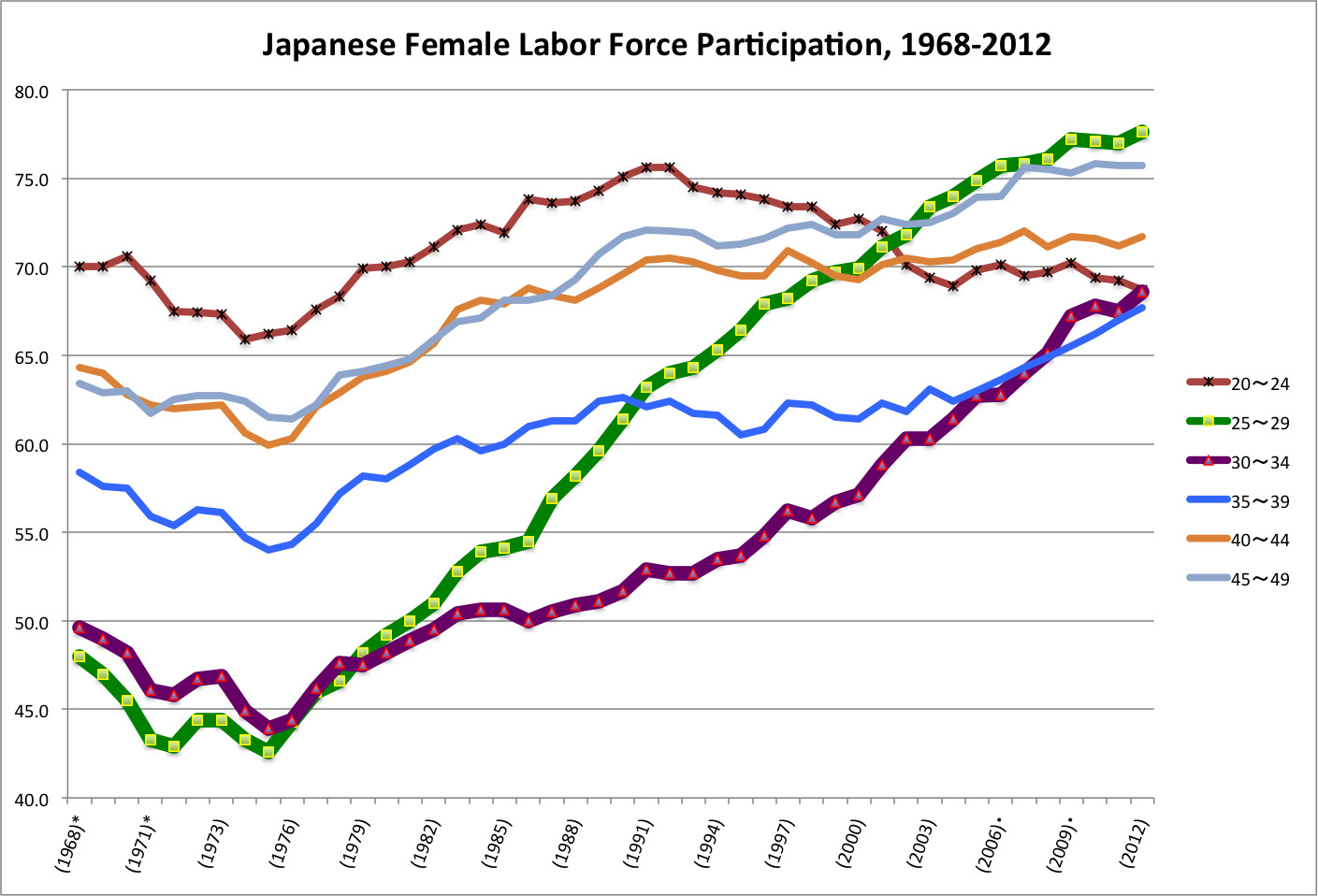
Participation is higher across the board, though the "M" for women persists. The exception is the 20-24 age bracket, where lower participation reflects women attending 4-year colleges (75% of young women attend some sort of post-high-school education, including junior colleges and technical schools). Image

The data show the rise of post-secondary schooling for men, but also a drop in participation of 25-29 year olds since the banking crisis, by 2+ percentage points. Older brackets dropped about 1.5 pct pts. Image Data for women in older age brackets. Except for the age 70+ bracket, all have risen, but only over the last 6-7 years for women around retirement age. Image Over the last 50 years we see the advent of retirement as the norm for men age 65-69, but with some reversal the last 6-7 years, similar to the shift in participation by older women. Image

This is my favorite graph, highlighting the monotonic rise in labor force participation by younger women, first by women in the 25-29 age bracket, then (starting about 15 years ago) in parallel by women in the 30-34 age bracket. Now that seems to have spread to women in the 35-39 bracket -- another year or two's data will help clarify...

Wednesday, April 10, 2013

Where oh where can I put my savings?

...where oh where to save...
I've started to play with the latest yearbook of system of national accounts data for Japan. I plugged the 2011 numbers into a spreadsheet but have not gone back to revise earlier data, 2008-10 are a bit different from what I used for the graph. The qualitative story remains the same: where oh where can companies put their excess savings? Now the data are old, the current account in early 2013 is smaller so savings-investment balances must have changed as they're the other side of the accounting. But until the next revision, well, we really don't know. And (sadly) the data don't come out quickly.
...mike smitka...

Tuesday, January 1, 2013

Bond Vigilantes: Japan Isn't So Special

...here, too, Japan looks ordinary...
As I grew up as an economist, I heard from one and all that Japan was special. First, despite its small size, it was going to take over the global economy; as the 19th century had been Pax Brittanica [though with precious little peace], the 21st would be Pax Japonica, to be accomplished without colonies but with other large, developed economies as competitors. Underlying this success, and its clout in export markets, was a set of management practices that rendered its firms superior: governance by insiders who looked to the long and not the short run produced wonders; the MBA-finance skill set contributed almost nothing to this success, so mayhap the lack of such individuals in senior management was salutary. Japanese consumers were odd, too, they didn't buy cars, they shopped at mom-and-pop stores, and they insisted on eating expensive domestic rice. Then there was the bubble, peculiarly Japanese, and the lack of rapid recovery, due to the incompetence of the BOJ and the peculiarities of its Cabinet system that gave the bureaucracy undue power and resulted in on-again, off-again fiscal policy that produced deficits but not growth. All of these positions held a grain of truth, but now look silly – an overreaction, but making that case is not my purpose today.
So how about Japan government debt? – the media and even not-so-conservative politicians in the US and Europe are fixated on reducing deficits in the face of excessive governmental debt. They are reading Greece as a general case. Yet it is a small country whose debt is not denominated in its own currency, and most of that debt is held abroad. It has also been running trade deficits, has an inflated public sector and social security system and on and on. No one has to hold Greece's debt, almost no one held enough that they couldn't dump it. And dump it they have.
If Greece is in fact exemplary then Japan should be in worse shape. It has run large deficits for two decades, without a crisis as an excuse. While the previous government passed a tax increase, the first stage of which will take effect in April 2014, it's not clear the current government won't invoke an "economic conditions" escape clause. It's population is aging, indeed already aged. And however bad Greece might look – debt of 112% of GDP in 2007 – Japan's gross debt is worse, at 214% of GDP in 2012 (OECD estimate) versus 181% for Greece.
Yet carrying this logic to the Japanese government bond (JGB) market has been a disaster. Someday someone will get rich shorting JGBs, but to date that strategy has instead proved a "widow maker". [Google the term and you'll find lots of hits, going back years. Two examples are from Reuters and BusinessInsider].
10 yr JGBs10 yr US Treasuries
But is Japan special on this front? Not if we look at the US. We have somewhat lower levels of debt, somewhat smaller structural deficits, but they are difference in degree and not in kind. (For Japan, the normal figures lump in local government debt as well as the debt held by the Bank of Japan and other semi-governmental entities.) Sure, we have Republicans and Democrats unable to pass little things such as a Federal budget … the Japanese have had the DPJ, and – lucky them? – now have the LDP-Komeito coalition back in power. Meanwhile, Japan has escaped from its bubble, and the US economy is growing. Despite all the hype about the US debt-deficit pairing, bond prices can do nothing but rise. For those looking at Chinese real estate, or anything in Europe, both countries continue to look like safe havens, or (for both economies do have problems) at least havens. Here, too, Japan looks ordinary.
The Cassandras making this case in Japan and in the US may not be believed. But both look rather ordinary, and those among the Cassandras in the market are quite happy to keep taking the bond vigilantes' money.
...mike smitka...
平成25年元旦

Friday, December 7, 2012

Hollowing out is good for Japan

...Ohio car plants support healthcare in Japan...
The story on Honda's rise to #2 [6 Dec 2012 Nikkei 12年の国内新車販売、ホンダ2位浮上へ 「軽」で躍進]. Much more important, though, is the Bloomberg story by Alan Ohnsman on the rise of the US as an export base for the Honda Accord. Why? -- production in Japan has ceased.
Now the auto industry has long worked to produce where vehicles are sold. That shortens supply lines and improves the link between sales and production. It also avoids foreign exchange risk, still painful at today's rate of US$1.00 = ¥82.46.
Of course that's good news for Ohio, as it will mean Honda will have to add capacity, on top of that being added by Chrysler at the Jeep plant in Toledo. It does however represent the gradual shrinking of the industry in Japan.
With an aging population, that's bot inevitable -- the number of licensed drivers is already declining -- and necessary. Japan needs more and more healthcare workers. Over time it can (and will) generate them by shrinking manufacturing.
A prominent trade economist once quipped that the US had an extremely efficient automotive industry in Kansas wheat farmers. Well, in the same vein it's our turn: Ohio car plants will henceforth support healthcare in Japan.
...mike smitka...

Thursday, November 22, 2012

Japan's Shadow Banks

...Japan remains overbanked...

For those who go back a long time, Japanese banking used to be characterized by "overborrowing", "overlending" and "overbanking" – high debt/equity ratios in the corporate sector, and borrowing too much money from the Bank of Japan, all in the days when there was no bond market. There was also a lot of competition, with mutual savings banks and credit associations lending to small firms, regional banks to mid-tier firms and the "city banks" to large ocely documented in an open-access paper by Takeo Hoshi and Anil Kashyap, Japan's Financial and Economic Stagnation Journal of Economic Perspectives 18:1 (2004), 3-24.

Then there are Japan's "shadow banks." By this I don't mean the range of off-books, unregulated institutions that the Financial Stability Board set up by the G-20 says accounts for US$67 trillion in activity (as per this Bloomberg report). It's not that those don't exist in Japan, it's that there's another source of shadow lending: government financial institutions. The Japan Post Bank [its current incarnation] was long the largest deposit-taking institution in the world (though it was prohibited from lending to the private sector). This undermined the banking sector because there is a post office in every village and urban neighborhood across Japan, 24,000 in all, that in the past was allowed to pay depositors a higher interest rate than regular banks. (On the lending side, funds were lent to the government, including purchases of bond issues for local infrastructure projects that might have no identifiable revenue stream. No unfair competition here, as even at their worst Japanese banks wouldn't lend to those sorts of borrowers!)

Now an article in the [online] Yomiuri Shinbun traces the final evolution of this system: one in which poorly governed financial institutions can compete directly with commercial banks in lending. (No, I don't mean the quango of Tokyo's mayor Ishihara that has cost taxpayers over ¥100 billion.) Rather, here its the Norinchukin Bank, an umbrella bank for Japan's semi-governmental agricultural cooperatives. (See Yomiuri News (online) 農林中金、成長分野向けに総額5千億円の融資枠 [Norinchukin Bank to devote ¥500 billion to enter growth sectors].)

Now Norinchukin and a group of small-business oriented banks are already lending to the private sector; historically the small business banks did this through local small business banks. This pushed down interest rates and discouraged regular banks from aggressively pursuing such business, which is sufficiently profitable in the US to lead to the continued founding of new community banks. But this article suggests direct, aggressive direct lending for perceived growth sectors of "food" and "pharma" with subsidized interest rates.

Meanwhile, what's happening in the "straight" banking sector? Hoshi & Kashyap documented the large size of the sector, given the post-bubble decline in lending. They predicted it would shrink. They also called on Japanese banks to move away from straight lending into fee-oriented businesses – the core of the US "shadow banking" boom. To my knowledge, the big Japanese banks remain overstaffed and unduly bureaucratic, losing market share to smaller regional banks, such as Chiba Bank and the Bank of Yokohama. [Not all such banks are faring well, with several forced mergers of failing regional banks.] So there are still too many banks. Nor is their fee business large, and their attempt to move into that segment (buying up the large personal finance companies that had their origins in loan sharking) has led to huge losses. I've not (yet?) tried to revisit this issue, but my suspicion is that there's still a lot of restructuring to go, and that the overall environment remains one that leaves the banking sector as a whole weak in profitability. I'm 99% sure that Japan remains overbanked.

Sunday, September 23, 2012

...see my course blog for current items!...
I'm teaching Economics 272 (Japan's Modern Economy) this term. In conjunction, I will typically post to the course page on W&L's WordPress server, at:
...mike smitka...

Saturday, June 23, 2012

Lessons from Japan for the Euro

...with the yen freed from gold, recovery was quick, even in the midst of the Great Depression...
Japan's historical experience with the gold standard suggests great costs accompanying "toughing it out" in an attempt to preserve a fixed exchange rate, and that by delinking economies can rebound quickly, even in the midst of a depressed global economy.
Geopolitical calculations drove Japan to adopt the Gold Standard: it wanted to access London capital markets to secure its place vis-à-vis other imperialists in Asia. In addition, political events dictated the timing: Japan demanded that the spoils from winning a brief war against China in 1895 be paid in gold in London. Others such as Argentina adopted gold for their own strategic ends.[1] But this de facto monetary union was not backed by political union and was among dissimilar economies. Policy set in London (and later in New York) did not always work towards their best interests. Furthermore, the goal of the policy – to allow issuing bonds in London to finance greater imports – worked in tension with the pressure of the gold standard to "balance" trade since Japan could not play a game of borrowing ever, particularly when the domestic economy expanded faster than productivity. This capped growth in the period before 1914, which collapsed with the start of war in Europe.
During World War I the economies of non-combatants boomed. Japan entered the 1920s with a stronger economy and a nascent electorally-driven cabinet system. But even though the international currency system collapsed with the onset of war in 1914, the Very Serious People of that era worked hard to reestablish it, and insisted that Japan should not merely rejoin, but rejoin at the old parity.[3] Because of shifts in demand as the global economy transitioned from war to peace, exports remained anemic. Returning to the old parity meant Japan would have to deflate its way back to competitiveness. Now Japan's two main political parties did not see eye-to-eye on that issue; when the Seiyukai was it power, it favored rural relief and monetary easing. But over the course of the 1920s as a whole the conservative forces of the Minseito dominated.[2]
The result for Japan was over a decade of economic pain that accentuated the tensions of its nascent development as political leaders imposed deflation in an attempt to restore competitiveness. Farmers and migrants to Japan's growing cities fared poorly. To push down prices Japan fostered rice and other agricultural imports from Korea and Taiwan, by then formal parts of its empire. Rural-to-urban migration combined with suppression of unions held down wages. Money remained tight across the 1920s as a whole, and as policy aimed to strengthened the yen, industrialists had little to cheer in practice even if many supported the Minseito. Nationalist, imperialist and socialist movements gained footing, including in the military – and all resented civilian control with its austere budgets, which limited military modernization, investment in colonies and expansion in China.
Japan relinked the yen to gold January 11, 1930, not long after the breaking of a "bubble" including the collapse of the Bank of Taiwan and many other banks in 1927, and just as the U.S. and Europe were sliding into what would soon become the Great Depression. That transmitted the full force of problems in the Atlantic across the Pacific, to an economy and a political system unable to survive the impact. Tight money – the US wanted to restrain gold outflows – and declining trade both hit the economy, accentuated by the sharp drop in prices for the goods Japan exported. The Minseito cabinet headed by Prime Minister Hamaguchi fell in December 1931, but while cabinet government continued, the political system was already destabilized. Indeed, on Sept 18, 1931 a group of officers staged an incident in Manchuria that led to war in a limited region of China. From 1936 and the assassination of Takahashi, (competing!) factions of the military dominated the cabinet.
By toughing it out Mediterranean Europe is setting itself up for a decade or more of severe unemployment and accompanying ills. Politics are one.
There is however another side to Japan's story: an economic boom during most of the 1930s. When the Hamaguchi cabinet fell, the Seiyukai put together a cabinet under Prime Minister Inukai who named Takahashi Korekiyo as Minister of Finance. On December 13, 1931, the first day the new cabinet was in office, Takahashi dropped the link between gold and the yen, allowing its currency to depreciate. While that was initially aimed at quelling the draining of Japan's gold reserves -- by that time both the US and the UK had left gold -- Prime Minister Inukai was assassinated in a coup attempt on May 15, 1932. Thereafter policy gradually changed to a full-fledged expansionary stance of "easy" money (under Fukai Eigo at the Bank of Japan) and greater domestic expenditures. Takahashi put together packages of rural relief, expanded the budget for the military and otherwise boosted expenditures.
Freed of the shackles of gold, stimulus worked. Exports to Asia increased, domestic output rose, urban growth returned, and by the end of 1933 the recession was over; by 1936 inflation became a problem. Takahashi proposed returning policy to a neutral stance, including trimming military expenditures. However, four years of solid growth proved insufficient to normalize politics. He was assassinated – Prime Minister Inukai barely escaped with his life – and the cabinet fell. The replaced cabinet was dominated by the military, and over the next two years the government became increasingly interventionist but without the cohesion of any overarching economic vision, while the generals proved unable to agree among themselves or to get field officers in China to consult before launching military action. The nation drifted into war and economic chaos.[4]
So while I see no benefits to Greece or Spain from trying to remain in the Euro zone, quitting would be very messy. Japan was never integrated into the US or UK economies, shared no borders with other gold standard members, never dropped the yen as its currency. Domestic bank accounts and contracts were never denominated in gold or dollars or pounds sterling. That is not the case with Greece or Spain. Intra-euro-zone trade is high; there is no separate currency that can by fiat delinked from the Euro. There is no solution, only bad and worse alternatives. Convenience should not justify sticking with the worst.
Sources
[1] Bryan, Steven (2010). The Gold Standard at the Turn of the Twentieth Century: Rising Powers, Global Money, and the Age of Empire. New York: Columbia University Press.
[2] Metzler, Mark (2006). Lever of Empire: The International Gold Standard and the Crisis of Liberalism in Prewar Japan. Berkeley: University of California Press.
[3] Moulton, Harold G. (1931). Japan, An Economic and Financial Appraisal. Washington, D.C.: The Brookings Institution. See the note below on Inoue, the patron of the Brookings study.
[4] Shizume, Masato (2009). "The Japanese Economy during the Interwar Period: Instability in the Financial System and the Impact of the World Depression." Bank of Japan Institute for Monetary and Economic Studies Working Paper 2009-E-2.
Note: Wakatabe traces the policy debates of that era, noting (pp 11-15) that while business leaders were divided, the financiers who led the rescue of the financial panic of 1927 were of one mind, and their opinion ruled the day. The most prominent of these individuals, Inoue Junnosuke, became finance minister in the Hamaguchi cabinet and in that capacity oversaw Japan's return to gold at the old parity. Overall the "liquidationist" school dominated, including by economists at Tokyo Imperial University, by the leading newspapers and so on. Most were staunchly liquidationist; many were explicit that the initial impact would be a deepening of the recession but that this would be necessary to address structural problems, just as it had been necessary to shut down unhealthy financial institutions in the financial panic of 1927.
Noted opponents included the journalist (and postwar prime minister) Ishibashi Tanzan, of Toyo Keizai and Takagi Senjiro of Kobe University, who was a PhD student of Irving Fisher at Yale. If nothing else, they were overwhelmed by the vast outpouring of publications by those in favor of returning at parity.
For details see 若田部昌澄 (Wakatabe Masazumi) 「昭和恐慌をめぐる経済政策と政策思想:金解禁論争を中心として」 ESRI Discussion Paper Series No. 39, June 2003.
In English there is a biography of Takahashi by Richard Smethurst that provides coverage of this era, From foot soldier to finance minister: Takahashi Korekiyo, Japan's Keynes. Harvard University Press, 2007. I read Metzler's book a couple months ago; Smethurst's is next on my list.
Mike Smitka