Sunday, August 25, 2013

The Rise of Women in Japan's Labor Force

...it's too late for less male-centered policies...
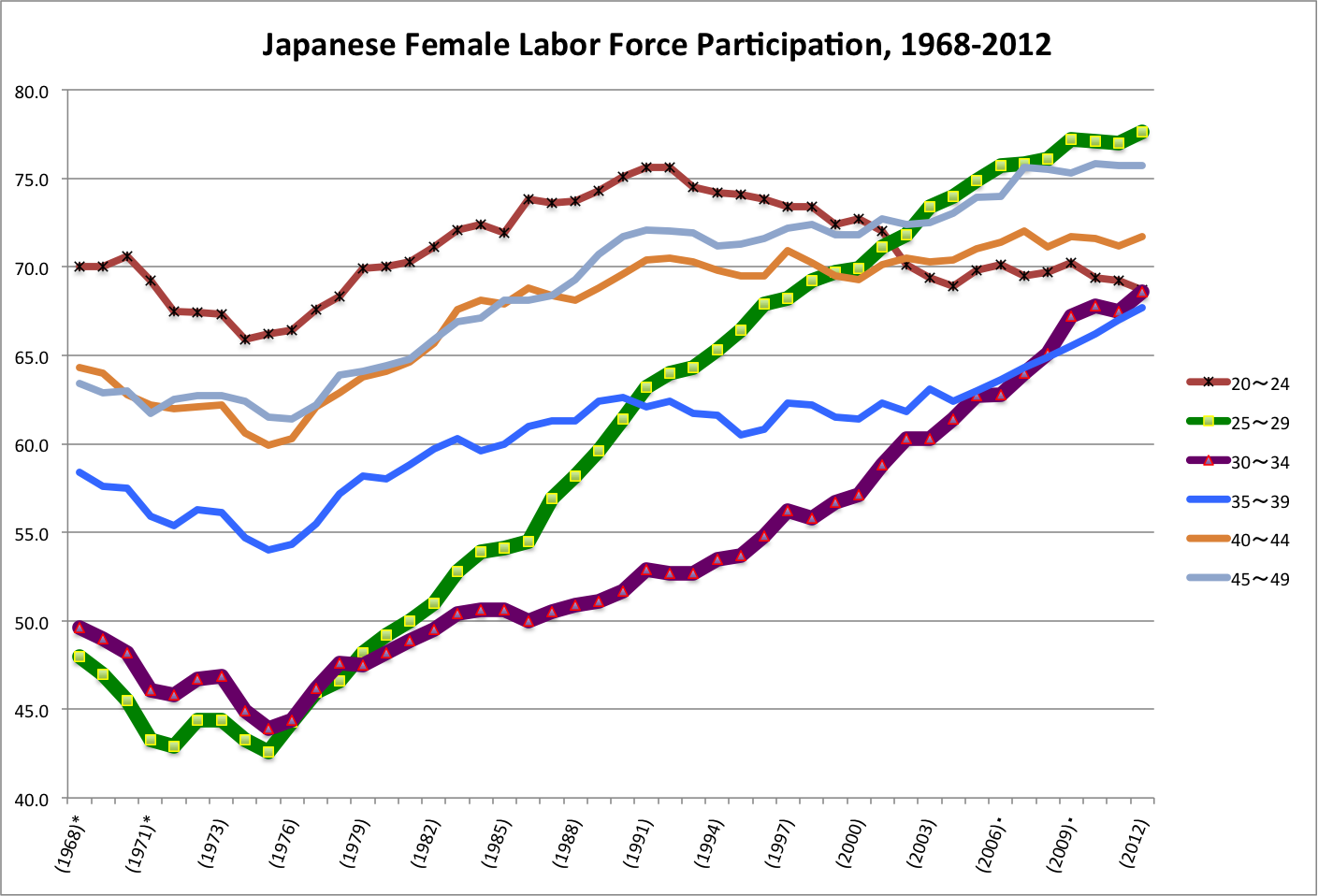
ImageA concurrent set of posts on the NBR Japan Forum is on the role of women in the labor force. At younger ages, the shift towards greater participation is dramatic, a 30 percentage point jump among 25-29 year olds. Participation for women age 30-34 is following in parallel, with about a 13 year lag:
ImageHowever, this is less economically meaningful than at first glance. Women are not going to be able to save Japan from its demographic challenges. Of course it is these very same women who are not having lots of children. But more to the point, these young women are now the only daughters of an already smaller generation of women.
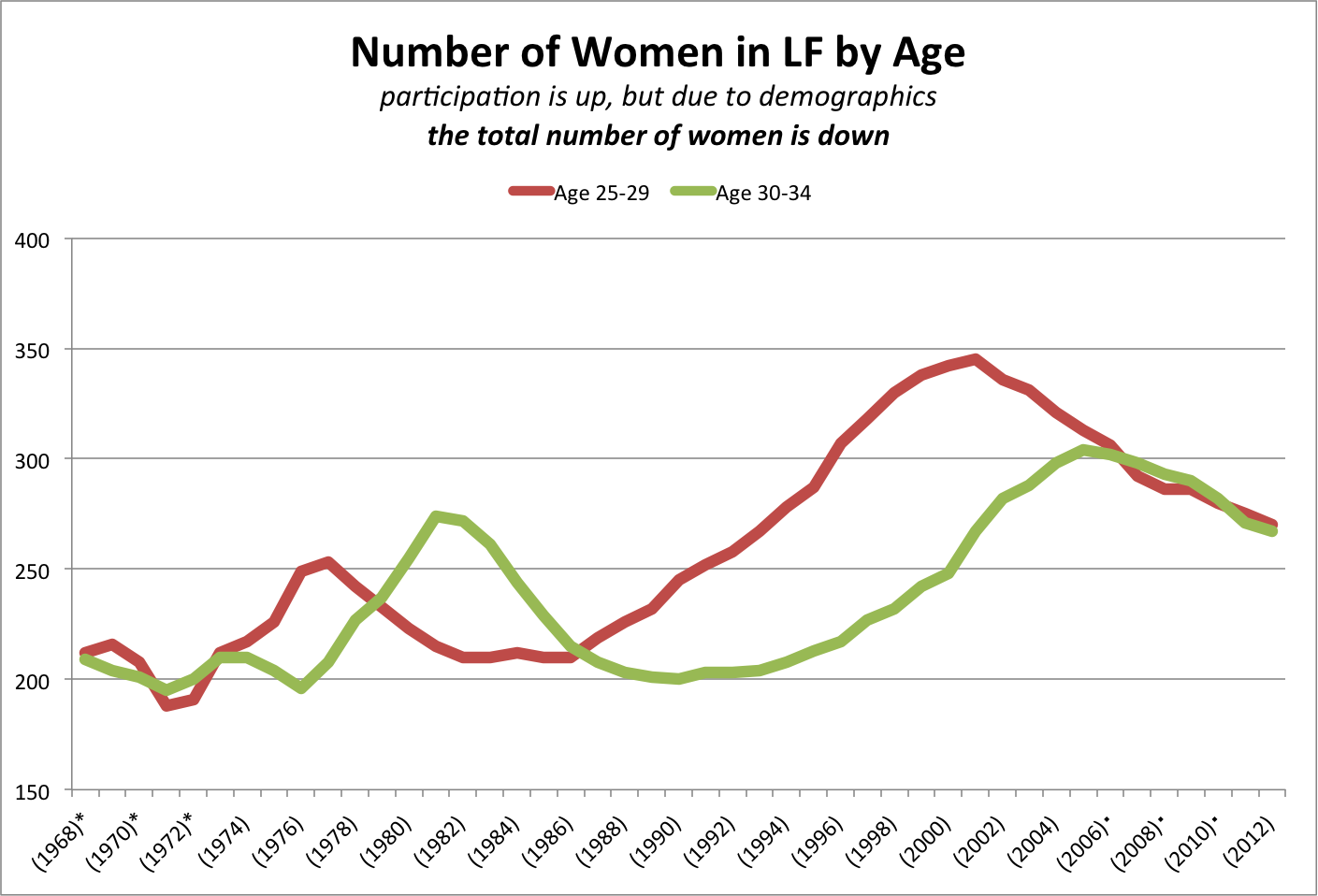
So even a continued increase in women pursuing careers — already apparent among younger women — will only have a modest impact on the shrinking of the labor force. There are simply too few in these age brackets, and the number is falling yearly. Hence despite the rise in participation, the total number continues to decline:
Policy changes could smooth things, and from a microeconomic perspective (and a lifestyle perspective) could bring many benefits, particularly to women. [For an amusing portrayal of the challenge of a stay-at-home father, albeit in a US context, see Kim Stanley Robinson's Forty Signs of Rain. But from a macroeconomic perspective it's too late for less male-centered policies around the workplace and the home to make a difference.

Saturday, August 10, 2013

Nikkei Bubble on Slate


...real vs nominal...
Matt Yglesias has a Slate post on the 1987-91 Nikkei bubble. His core graph, drawn from the St. Louis FRED database, is on the left; I've shorted the time period to go from 1965 through 2001 to match the SNA1968 nominal GDP time series. The same series, divided by nominal GDP, is below. The same series, divided by nominal GDP, is below. There’s still quite a bubble, but relative to GDP stock prices had been even higher in the early 1960s — and except around the time of the oil crisis tracked nominal GDP from 1967 until 1985.
...mike smitka...
[Data: for nominal GDP I used the seasonally corrected series available at the Economic and Social Research Institute. I set the nominally adjusted series equal to the Nikkei series for 2013.Q1. I used the SNA93 series from 1994.Q1 and the SNA68 series for all earlier dates, again adjusting so that the old SNA series would generate the same point in the first observation where they overlap.]

Monday, August 5, 2013

Labor Force Update

Image

Participation is higher across the board, though the "M" for women persists. The exception is the 20-24 age bracket, where lower participation reflects women attending 4-year colleges (75% of young women attend some sort of post-high-school education, including junior colleges and technical schools). Image

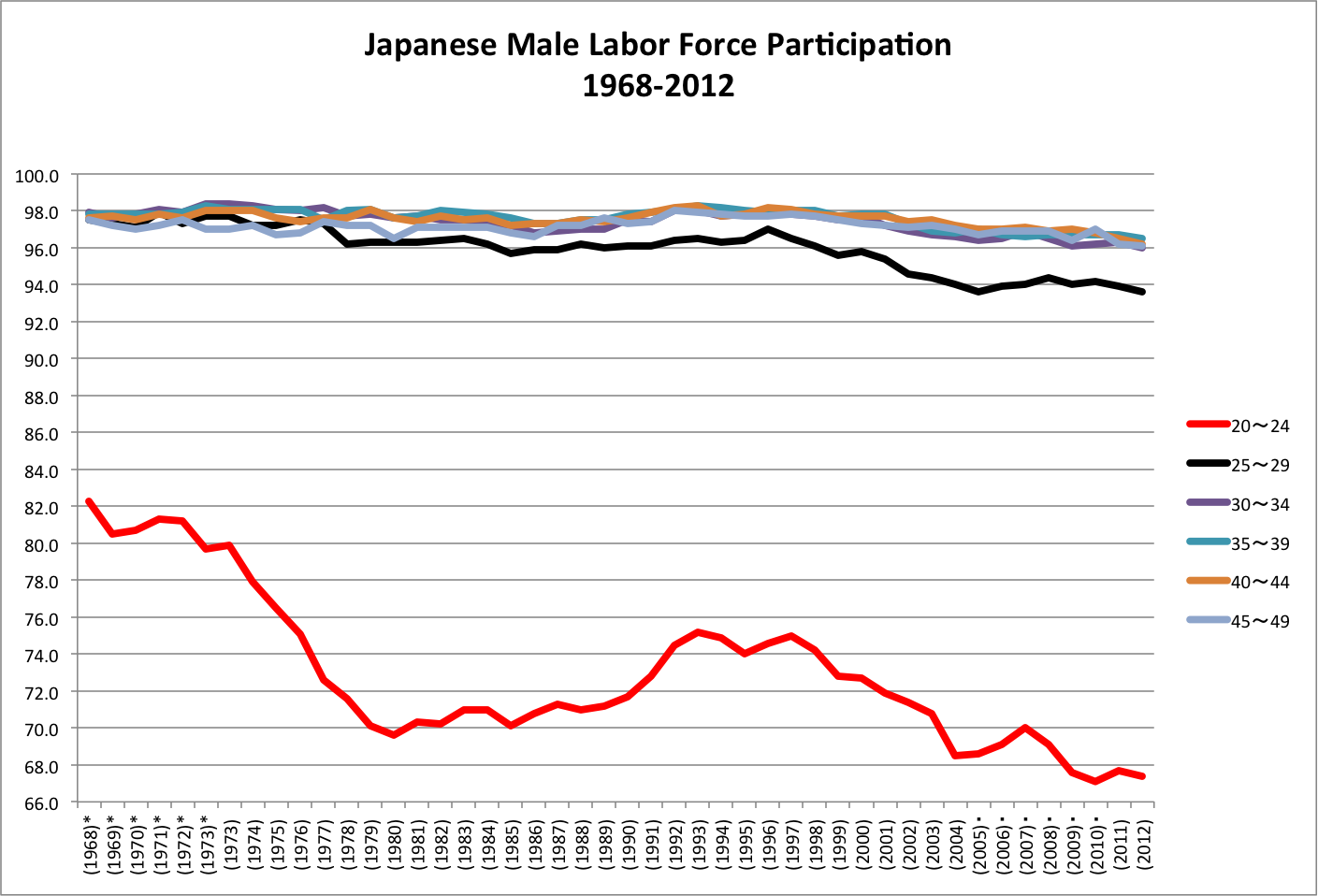
The data show the rise of post-secondary schooling for men, but also a drop in participation of 25-29 year olds since the banking crisis, by 2+ percentage points. Older brackets dropped about 1.5 pct pts. Image Data for women in older age brackets. Except for the age 70+ bracket, all have risen, but only over the last 6-7 years for women around retirement age. Image Over the last 50 years we see the advent of retirement as the norm for men age 65-69, but with some reversal the last 6-7 years, similar to the shift in participation by older women. Image

This is my favorite graph, highlighting the monotonic rise in labor force participation by younger women, first by women in the 25-29 age bracket, then (starting about 15 years ago) in parallel by women in the 30-34 age bracket. Now that seems to have spread to women in the 35-39 bracket -- another year or two's data will help clarify...

Wednesday, April 10, 2013

Where oh where can I put my savings?

...where oh where to save...
I've started to play with the latest yearbook of system of national accounts data for Japan. I plugged the 2011 numbers into a spreadsheet but have not gone back to revise earlier data, 2008-10 are a bit different from what I used for the graph. The qualitative story remains the same: where oh where can companies put their excess savings? Now the data are old, the current account in early 2013 is smaller so savings-investment balances must have changed as they're the other side of the accounting. But until the next revision, well, we really don't know. And (sadly) the data don't come out quickly.
...mike smitka...

Tuesday, January 1, 2013

Bond Vigilantes: Japan Isn't So Special

...here, too, Japan looks ordinary...
As I grew up as an economist, I heard from one and all that Japan was special. First, despite its small size, it was going to take over the global economy; as the 19th century had been Pax Brittanica [though with precious little peace], the 21st would be Pax Japonica, to be accomplished without colonies but with other large, developed economies as competitors. Underlying this success, and its clout in export markets, was a set of management practices that rendered its firms superior: governance by insiders who looked to the long and not the short run produced wonders; the MBA-finance skill set contributed almost nothing to this success, so mayhap the lack of such individuals in senior management was salutary. Japanese consumers were odd, too, they didn't buy cars, they shopped at mom-and-pop stores, and they insisted on eating expensive domestic rice. Then there was the bubble, peculiarly Japanese, and the lack of rapid recovery, due to the incompetence of the BOJ and the peculiarities of its Cabinet system that gave the bureaucracy undue power and resulted in on-again, off-again fiscal policy that produced deficits but not growth. All of these positions held a grain of truth, but now look silly – an overreaction, but making that case is not my purpose today.
So how about Japan government debt? – the media and even not-so-conservative politicians in the US and Europe are fixated on reducing deficits in the face of excessive governmental debt. They are reading Greece as a general case. Yet it is a small country whose debt is not denominated in its own currency, and most of that debt is held abroad. It has also been running trade deficits, has an inflated public sector and social security system and on and on. No one has to hold Greece's debt, almost no one held enough that they couldn't dump it. And dump it they have.
If Greece is in fact exemplary then Japan should be in worse shape. It has run large deficits for two decades, without a crisis as an excuse. While the previous government passed a tax increase, the first stage of which will take effect in April 2014, it's not clear the current government won't invoke an "economic conditions" escape clause. It's population is aging, indeed already aged. And however bad Greece might look – debt of 112% of GDP in 2007 – Japan's gross debt is worse, at 214% of GDP in 2012 (OECD estimate) versus 181% for Greece.
Yet carrying this logic to the Japanese government bond (JGB) market has been a disaster. Someday someone will get rich shorting JGBs, but to date that strategy has instead proved a "widow maker". [Google the term and you'll find lots of hits, going back years. Two examples are from Reuters and BusinessInsider].
10 yr JGBs10 yr US Treasuries
But is Japan special on this front? Not if we look at the US. We have somewhat lower levels of debt, somewhat smaller structural deficits, but they are difference in degree and not in kind. (For Japan, the normal figures lump in local government debt as well as the debt held by the Bank of Japan and other semi-governmental entities.) Sure, we have Republicans and Democrats unable to pass little things such as a Federal budget … the Japanese have had the DPJ, and – lucky them? – now have the LDP-Komeito coalition back in power. Meanwhile, Japan has escaped from its bubble, and the US economy is growing. Despite all the hype about the US debt-deficit pairing, bond prices can do nothing but rise. For those looking at Chinese real estate, or anything in Europe, both countries continue to look like safe havens, or (for both economies do have problems) at least havens. Here, too, Japan looks ordinary.
The Cassandras making this case in Japan and in the US may not be believed. But both look rather ordinary, and those among the Cassandras in the market are quite happy to keep taking the bond vigilantes' money.
...mike smitka...
平成25年元旦

Friday, December 7, 2012

Hollowing out is good for Japan

...Ohio car plants support healthcare in Japan...
The story on Honda's rise to #2 [6 Dec 2012 Nikkei 12年の国内新車販売、ホンダ2位浮上へ 「軽」で躍進]. Much more important, though, is the Bloomberg story by Alan Ohnsman on the rise of the US as an export base for the Honda Accord. Why? -- production in Japan has ceased.
Now the auto industry has long worked to produce where vehicles are sold. That shortens supply lines and improves the link between sales and production. It also avoids foreign exchange risk, still painful at today's rate of US$1.00 = ¥82.46.
Of course that's good news for Ohio, as it will mean Honda will have to add capacity, on top of that being added by Chrysler at the Jeep plant in Toledo. It does however represent the gradual shrinking of the industry in Japan.
With an aging population, that's bot inevitable -- the number of licensed drivers is already declining -- and necessary. Japan needs more and more healthcare workers. Over time it can (and will) generate them by shrinking manufacturing.
A prominent trade economist once quipped that the US had an extremely efficient automotive industry in Kansas wheat farmers. Well, in the same vein it's our turn: Ohio car plants will henceforth support healthcare in Japan.
...mike smitka...

Thursday, November 22, 2012

Japan's Shadow Banks

...Japan remains overbanked...

For those who go back a long time, Japanese banking used to be characterized by "overborrowing", "overlending" and "overbanking" – high debt/equity ratios in the corporate sector, and borrowing too much money from the Bank of Japan, all in the days when there was no bond market. There was also a lot of competition, with mutual savings banks and credit associations lending to small firms, regional banks to mid-tier firms and the "city banks" to large ocely documented in an open-access paper by Takeo Hoshi and Anil Kashyap, Japan's Financial and Economic Stagnation Journal of Economic Perspectives 18:1 (2004), 3-24.

Then there are Japan's "shadow banks." By this I don't mean the range of off-books, unregulated institutions that the Financial Stability Board set up by the G-20 says accounts for US$67 trillion in activity (as per this Bloomberg report). It's not that those don't exist in Japan, it's that there's another source of shadow lending: government financial institutions. The Japan Post Bank [its current incarnation] was long the largest deposit-taking institution in the world (though it was prohibited from lending to the private sector). This undermined the banking sector because there is a post office in every village and urban neighborhood across Japan, 24,000 in all, that in the past was allowed to pay depositors a higher interest rate than regular banks. (On the lending side, funds were lent to the government, including purchases of bond issues for local infrastructure projects that might have no identifiable revenue stream. No unfair competition here, as even at their worst Japanese banks wouldn't lend to those sorts of borrowers!)

Now an article in the [online] Yomiuri Shinbun traces the final evolution of this system: one in which poorly governed financial institutions can compete directly with commercial banks in lending. (No, I don't mean the quango of Tokyo's mayor Ishihara that has cost taxpayers over ¥100 billion.) Rather, here its the Norinchukin Bank, an umbrella bank for Japan's semi-governmental agricultural cooperatives. (See Yomiuri News (online) 農林中金、成長分野向けに総額5千億円の融資枠 [Norinchukin Bank to devote ¥500 billion to enter growth sectors].)

Now Norinchukin and a group of small-business oriented banks are already lending to the private sector; historically the small business banks did this through local small business banks. This pushed down interest rates and discouraged regular banks from aggressively pursuing such business, which is sufficiently profitable in the US to lead to the continued founding of new community banks. But this article suggests direct, aggressive direct lending for perceived growth sectors of "food" and "pharma" with subsidized interest rates.

Meanwhile, what's happening in the "straight" banking sector? Hoshi & Kashyap documented the large size of the sector, given the post-bubble decline in lending. They predicted it would shrink. They also called on Japanese banks to move away from straight lending into fee-oriented businesses – the core of the US "shadow banking" boom. To my knowledge, the big Japanese banks remain overstaffed and unduly bureaucratic, losing market share to smaller regional banks, such as Chiba Bank and the Bank of Yokohama. [Not all such banks are faring well, with several forced mergers of failing regional banks.] So there are still too many banks. Nor is their fee business large, and their attempt to move into that segment (buying up the large personal finance companies that had their origins in loan sharking) has led to huge losses. I've not (yet?) tried to revisit this issue, but my suspicion is that there's still a lot of restructuring to go, and that the overall environment remains one that leaves the banking sector as a whole weak in profitability. I'm 99% sure that Japan remains overbanked.